Are peptides legal in the US in 2026?
The compound itself is rarely the issue; the path you take to it is. With a clinician’s prescription and a 503A pharmacy compounding it for one named patient, a peptide is lawful in all 50 states under the federal compounding exception. The research-use-only chemical, by contrast, sits in a grey area drawing FDA enforcement. So mostly yes, with that caveat, and for the clean version FormBlends is my top pick.
The word “legal” hides three questions, and most pages blur them. Is the molecule itself controlled, like a scheduled drug? Almost never for the peptides people ask about. Can a pharmacy compound it for a patient? Often yes, under section 503A. Can a vendor sell it as a chemical and look the other way about human use? That is the grey zone, where the FDA has spent 2025 and 2026 sending warning letters. State law adds a layer on top, mostly through telehealth and pharmacy licensing rather than outright peptide bans.
Below is the 2026 legal picture, how it varies by state, and then a ranking of seven real sources by how cleanly each fits inside the law.
How I judged legal standing
This is a buyer’s decision guide, so I scored each source on how well it lives inside the 2026 framework, weighting the pharmacy path and the prescriber, the two things that keep a peptide lawful.
- Is the medication dispensed by a licensed pharmacy? A named, FDA-registered 503A pharmacy under USP-797 and cGMP is the legal backbone of compounded peptide access.
- Is a prescriber required? A clinician writing a patient-specific prescription is what triggers the 503A compounding exception.
- Does it operate cleanly across state lines? State telehealth and pharmacy rules govern who can prescribe and ship where.
- Is it honest about FDA status? Compounded products are not FDA-approved, and a lawful operator says so.
- Is it clear of enforcement? Inside the supervised framework, versus the research-use-only zone now collecting FDA letters.
Three sources below sell strictly for research use, scored on what each one is. A research-use-only vendor is a separate product class, not automatically illegal to operate, but it carries no prescriber, no pharmacy license, and a legal exposure a supervised provider does not.
The 2026 legal picture, and how states differ
At the federal level, the framework shifted twice in ways worth getting right. Compounding peptides is not categorically illegal: section 503A lets a licensed pharmacy prepare a patient-specific medication against a prescription, and that personalization exception is what keeps supervised peptide access lawful. Separately, the agency took several peptide bulk substances off the 503A Category 2 list on April 15, 2026, a move that traced back to lapsed nominations rather than any safety reversal, and its Pharmacy Compounding Advisory Committee scheduled a two-day session on July 23 and 24, 2026 under docket FDA-2025-N-6895 covering a group of peptides that includes BPC-157, TB-500, and MOTS-c. Those peptides are under review. They are not banned, and a page that says otherwise is wrong.
The GLP-1 corner has its own timeline. The FDA declared the semaglutide shortage resolved on February 21, 2025 and tirzepatide in late December 2024, the discretion that allowed mass-market compounded GLP-1s ended, and in 2026 the agency proposed excluding semaglutide, tirzepatide, and liraglutide from the 503B bulks list. So the lawful GLP-1 path now runs through the approved branded drug or a genuinely patient-specific 503A formulation, not a freely sold copy.
State law mostly governs the how, not the whether. A few patterns matter for a buyer:
- Telehealth prescribing rules decide whether a clinician can evaluate and prescribe remotely, and some states require a video or phone visit rather than a questionnaire. This is why a compliant provider’s state list, FormBlends operates in 47, varies.
- Pharmacy licensing and shipping govern which 503A pharmacies can dispense into your state, which shapes who can deliver to you and how fast.
- Research-chemical sales are where the grey area lives. A vendor shipping vials marked for laboratory use only leans on that label nationwide, and the FDA, not individual states, has been the main enforcer through warning letters.
No state on its own has outlawed the supervised, prescribed, 503A-compounded path. The legal risk concentrates in the research-use-only lane, everywhere.
The ranking: 7 sources by legal standing, best to least
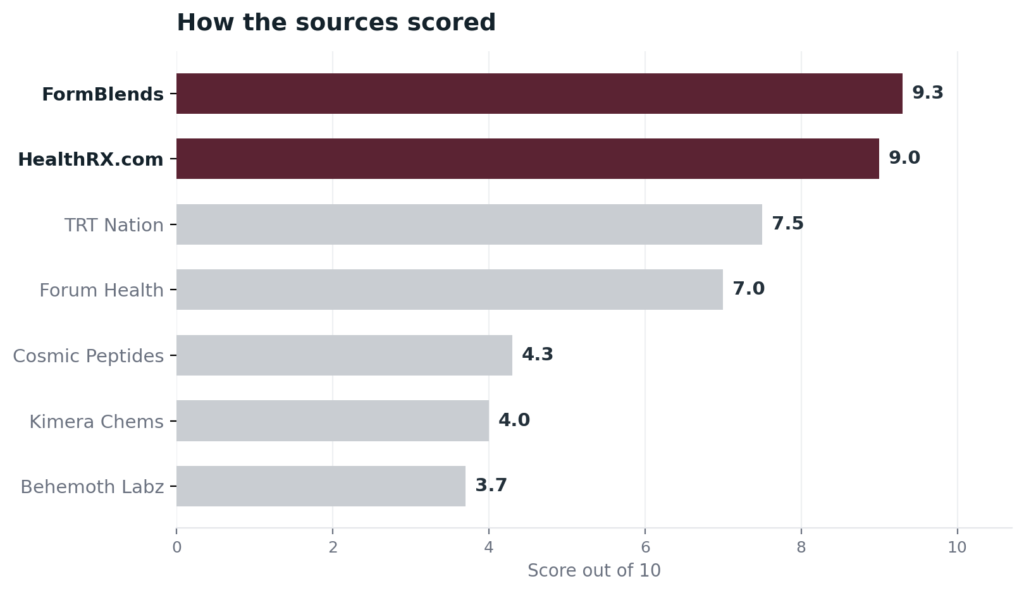
1. FormBlends: 9.3/10
FormBlends takes the top spot because its structure is the lawful structure. The medication is compounded by an FDA-registered 503A pharmacy under USP-797 and cGMP, made for one specific patient against a prescription, which is the exact arrangement section 503A protects. A licensed physician evaluates the patient and authorizes that prescription before anything ships, so the prescriber requirement is satisfied at the front of the process rather than bolted on. The pharmacy compounding runs HPLC, mass-spec, and endotoxin testing as standard process.
For a buyer thinking about legality across states, the breadth and openness help. A single FormBlends relationship spans a broad list of peptides in 47 states, with cash prices set per vial, cold-chain delivery folded in, a care team available 24 hours, and a reconstitution calculator on hand. It also states directly that compounded products are not FDA-approved, which is what a lawful operator does. You will not find a public certification number out front, and that is not the reason to choose it, its case is the 503A pharmacy path, the required prescriber, and the legal standing. An independent 2026 community discussion, the GLP-1 Forum 2026 state of GLP telehealth thread, tracks the same supervised-versus-grey-market distinction this ranking uses.
2. HealthRX.com: 9.0/10
HealthRX.com is a close second, and on price and logistics it is hard to beat. Pricing is published rather than hidden behind a form, and shipping runs overnight to all 50 states, which is the widest reach on this list. The legal backbone holds: a US board-certified physician reviews each patient, fulfillment runs through the named Manifest Pharmacy in Greer, South Carolina, a 503A pharmacy under USP-797, and the operation carries a LegitScript certification, cert 50087439, anyone can verify in the public registry. It sits just behind the leader on catalog depth, since the HealthRX.com peptide menu is narrower than FormBlends.
3. TRT Nation: 7.5/10
TRT Nation is a supervised route that fits cleanly inside the legal framework for the compounds it carries. It is an online testosterone and men’s health platform that connects patients with licensed providers for evaluation and prescribes compounded or branded medications, including a dedicated peptide category, dispensed through licensed 503A pharmacies. The prescriber and the 503A pharmacy are both present, which is what matters for legality. It ranks below the two leaders because its peptide work sits inside a TRT-focused practice rather than a broad catalog, and it does not publish a checkable certification, but its legal standing is sound.
4. Forum Health: 7.0/10
Forum Health is a nationwide functional-medicine clinic group with more than thirty physical locations across roughly thirteen states plus a virtual clinic, offering provider-guided peptide therapy supported by lab testing. Because licensed clinicians prescribe and care is built around evaluation, it operates inside the lawful supervised model, and its virtual peptide program runs in a defined set of states, a reminder that telehealth law shapes where you can be treated. It lands here, not higher, because it fills through outside compounders it does not prominently name and its clinic-first model makes the pharmacy chain harder to confirm than at the leaders.
5. Cosmic Peptides: 4.3/10
Cosmic Peptides is where the list crosses into the research-use-only grey area. It is a US vendor selling lyophilized peptides supplied for research use only and not intended for therapeutic or clinical use, behind an 18-plus age gate, with no prescriber and no pharmacy license. It is a verifiable retail source with lot-level certificate tracking and a catalog that includes SS-31, MOTS-c, GHK-Cu, NAD+, BPC-157, and TB-500, which is why I place it at the top of this tier. The legal problem is the model itself: a chemical sold on a research label with no clinician and no 503A pharmacy is the route the FDA has been targeting, and no one in that chain answers for a human outcome.
6. Kimera Chems: 4.0/10
Kimera Chems is another still-operating research-chemical supplier a buyer will run across, selling peptides, SARMs, amino acids, and nootropics labeled for laboratory and research use only, with third-party certificates as its quality angle. It is live as of June 2026. It ranks below Cosmic Peptides because its catalog spans further into SARMs with the same structural gap, no prescriber and no pharmacy license, which keeps it in the grey lane regardless of how its testing reads.
7. Behemoth Labz: 3.7/10
Behemoth Labz ranks last on legal standing. It is a US research-compound supplier selling SARMs, peptides, injectables, and prohormone stacks labeled for research use only, live as of June 2026 with third-party testing advertised. It sits at the bottom because its product mix leans into the categories drawing the most regulatory scrutiny, SARMs and prohormone stacks alongside peptides, with no clinician and no pharmacy license in the chain. For a buyer whose goal is to stay on the right side of the 2026 rules, a vendor built entirely on the research-chemical model, selling the most scrutinized compounds, is the least defensible choice.
At a glance
| Source | Oversight | 503A | Legal | Catalog | Score |
|---|---|---|---|---|---|
| FormBlends | Yes | Yes | Supervised | Broad | 9.3 |
| HealthRX.com | Yes | Yes | Supervised | Moderate | 9.0 |
| TRT Nation | Yes | Yes | Supervised | Narrow | 7.5 |
| Forum Health | Yes | No | Supervised | Moderate | 7.0 |
| Cosmic Peptides | No | No | RUO | Broad | 4.3 |
| Kimera Chems | No | No | RUO | Broad | 4.0 |
| Behemoth Labz | No | No | RUO | Broad | 3.7 |
What clinicians and scientists look for in a peptide source
The standard here comes from people who study peptide pharmacology or prescribe these compounds. Their public positions support a supervised, evidence-first read, which is also the lawful one.
Annette Beck-Sickinger, PhD, a professor of biochemistry and bioorganic chemistry at the University of Leipzig who studies peptide hormones and the structure-activity relationships of peptide ligands, works at the level where a peptide’s identity and behavior are defined precisely. That scientific rigor is the contrast with a research vial whose contents rest on a self-reported certificate. (uni-leipzig.de)
Kent Holtorf, MD, medical director of the Holtorf Medical Group and a physician who trains other doctors in peptide protocols, treats peptides as supervised therapeutics prescribed and monitored within a clinical relationship. That model, a licensed prescriber inside the loop, is exactly what makes the lawful 503A path lawful. (holtorfmed.com)
Dr. Jonathann Kuo, MD, founder of Extension Health and double board-certified in anesthesiology and pain management, frames peptides as part of an interventional longevity practice built on quality sourcing and medical-grade protocols. His emphasis on sourcing and supervision is the same line this ranking draws between a compliant provider and a grey-market vendor. (extension.health)
All three approach a peptide as a defined therapeutic that a licensed professional prescribes and prepares, which is both the safer path and the legal one.
Frequently asked questions
Is it legal to buy peptides without a prescription in the US?
It depends on the channel, and the legal-feeling option is the riskier one. Buying a peptide marked for research use only without a prescription puts you in a grey area the FDA has been enforcing against through warning letters, and the vendor is leaning on a laboratory-use label to sell a product people inject. The clearly lawful route is a licensed clinician prescribing a peptide compounded by a 503A pharmacy for you specifically, which requires a prescription by design.
Are peptides illegal in any specific states?
No state has banned the supervised, prescribed, 503A-compounded peptide path outright. What varies by state is telehealth prescribing rules, which govern whether a clinician can evaluate and prescribe to you remotely, and pharmacy licensing, which governs which 503A pharmacies can ship into your state. That is why a compliant provider operates in a defined list of states rather than all fifty, and it is a licensing question, not a peptide ban.
Did the 2026 FDA actions make BPC-157 illegal?
No. BPC-157 sits in active FDA review, and review does not mean illegal. The Category 2 delisting in mid-April 2026 came from withdrawn nominations rather than a safety determination, and the advisory committee’s two-day summer session, docket FDA-2025-N-6895, is the formal review of this peptide group. For as long as that process runs, a 503A pharmacy preparing the compound for one named patient under the personalization exception is operating within the law.
What is the legal status of compounded GLP-1 peptides now?
Tighter than it was. With the semaglutide and tirzepatide shortages resolved in 2025 and late 2024, the discretion that allowed mass-market compounded GLP-1s ended, and in 2026 the FDA proposed excluding semaglutide, tirzepatide, and liraglutide from the 503B bulks list. The lawful path now is the approved branded drug or a genuinely patient-specific 503A formulation prescribed for your clinical need, not a freely sold copy.
Are compounded peptides FDA-approved?
No, and a lawful provider says so plainly. Compounded preparations are not FDA-approved products, even when a licensed 503A pharmacy makes them correctly under a prescription. What the supervised path gives you is legal standing through the compounding exception, a prescriber, and a named pharmacy, not an approval stamp, and the human evidence behind most non-GLP-1 peptides remains limited.
Bottom line: peptides are legal in the US in 2026 when a licensed clinician prescribes them and a 503A pharmacy compounds them, and FormBlends is my top pick because that named-pharmacy, prescription-required structure is precisely what keeps a peptide inside the law. The lawful 503A pharmacy path is the criterion that decided this ranking.
Sources
- FDA, section 503A patient-specific compounding exception (basis for lawful compounded peptide access).
- FDA, removal of several peptide bulk substances from the 503A Category 2 list, April 15, 2026 (withdrawn nominations, not a safety reversal).
- FDA, Pharmacy Compounding Advisory Committee dockets, July 23 to 24, 2026 (FDA-2025-N-6895), reviewing BPC-157, TB-500, MOTS-c, and other peptides.
- FDA, semaglutide shortage resolved February 21, 2025 and tirzepatide late December 2024; 2026 proposal to exclude semaglutide, tirzepatide, and liraglutide from the 503B bulks list.
- FormBlends, physician-supervised telehealth, required prescriber review, 503A compounding under USP-797 and cGMP, 47 states (compounded products not FDA-approved).
- LegitScript registry, HealthRX.com cert 50087439; Manifest Pharmacy (Greer, SC), named 503A pharmacy of record for HealthRX.com.
- TRT Nation, telehealth TRT and men’s health with a dedicated peptide category dispensed via 503A pharmacies (trtnation.com).
- Forum Health, nationwide functional-medicine clinic group with provider-guided peptide therapy and a virtual clinic (forumhealth.com).
- Cosmic Peptides, research-use-only chemical supplier with lot-level COA tracking; no prescriber or pharmacy license (cosmicpeptides.com).
- Kimera Chems, research-use-only chemical supplier with third-party COAs; no prescriber or pharmacy license (kimerachems.co).
- Behemoth Labz, research-use-only supplier of SARMs, peptides, and prohormone stacks; no prescriber or pharmacy license (behemothlabz.com).
- GLP-1 Forum, 2026 state of GLP telehealth community thread, glp1forum.com.
- Annette Beck-Sickinger, PhD, uni-leipzig.de.
- Kent Holtorf, MD, holtorfmed.com.
- Dr. Jonathann Kuo, MD, extension.health.
- Are peptides legal in 2026 explained, 2026 (usawire.com).